
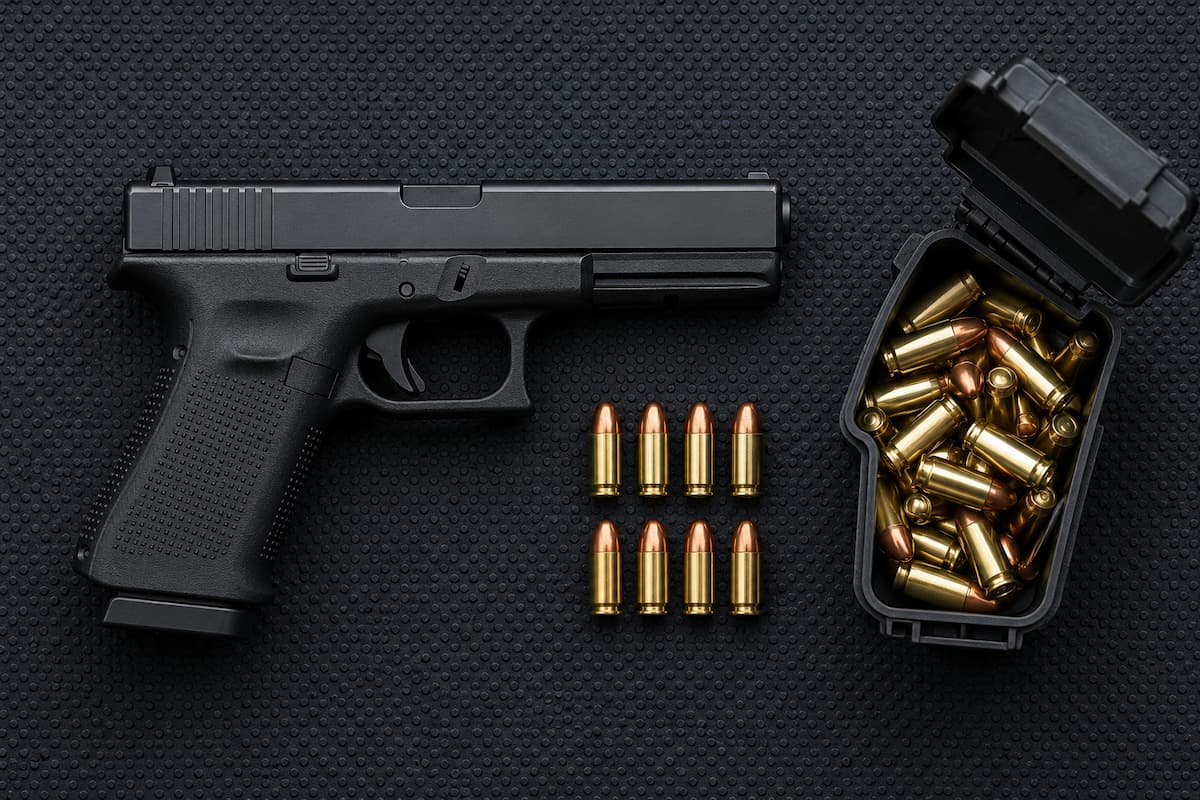
Both 115gr and 124gr 9mm will cycle most modern pistols.
The difference: 124 grain is the historic, long-standing NATO standard (STANAG 4090 / U.S. M882 ball) that defined modern full-size 9mm duty and cycling specs, and it carries more momentum into the slide.
The 115gr is lighter and a little faster. The 124gr is heavier, a little slower, and gives a fuller push. Here’s what that means at the range.
The Short Answer: 115gr vs. 124gr
- 124gr: the classic NATO benchmark weight, more momentum, a strong all-around training choice.
- 115gr: lighter and faster, common at ranges, and a fine choice if your pistol runs it well.
- Both: test a box in your own pistol before you buy in bulk. Your gun gets the final vote.
What “Grain” Means in 9mm
Grain is a unit of weight. One pound equals 7,000 grains, so a 124gr bullet weighs a little under 1/56 of a pound.
In 9mm Luger, the three common weights are:
- 115gr: the lightest common weight
- 124gr: the middle weight
- 147gr: the heavy weight, often subsonic
Grain describes the bullet only. It says nothing about powder charge or bullet type.
115gr vs. 124gr by the Numbers
The cleanest way to compare is the same maker, same bullet type, and same test barrel. Federal publishes exactly that for its American Eagle Full Metal Jacket (FMJ) loads, both from a 4-inch test barrel. Here’s Federal’s 124gr FMJ data next to its 115gr FMJ:
American Eagle 9mm 115gr FMJ
- Muzzle velocity: 1,180 fps
- Muzzle energy: 356 ft-lb
American Eagle 9mm 124gr FMJ
- Muzzle velocity: 1,150 fps
- Muzzle energy: 364 ft-lb
The 115 is 30 fps faster. The 124 still carries slightly more energy, and noticeably more momentum.
Momentum: The Number That Matters for Cycling
Momentum is mass times velocity (p = mv). Using Federal’s numbers:
- 115gr: 115 × 1,180 = 135,700 grain-feet per second
- 124gr: 124 × 1,150 = 142,600 grain-feet per second
That’s about 5% more momentum from the 124gr. Every bit of momentum the bullet carries forward pushes back on the gun, and that rearward push is what drives the slide.
Why 124 Grain Became the NATO Benchmark
For decades, the NATO 9x19mm ball load, known in the U.S. as the M882, used a 124-grain round-nose FMJ bullet. That made 124 grains the baseline weight for a military 9mm ball for a long time.
A note on what’s changed: While the U.S. Military recently adopted the 115gr M1152 ball for the M17/M18 service pistols, 124-grain remains the classic NATO benchmark that defined modern 9mm slide velocity, recoil spring tension, and duty performance.
That history is why 124gr is still the reference point many shooters use when they say a pistol “runs 9mm.”
How Bullet Weight Affects Handgun Cycling
Many shooters assume a lighter, faster bullet always means a softer, easier-running gun. However, the slide doesn’t care about speed alone. It cares about the total push it gets.
Here’s the cycle in plain terms:
- The shot fires. The bullet moves forward, and the gun moves back with equal momentum.
- The slide travels rearward. It has to compress the recoil spring, extract the empty case, and eject it.
- The spring returns the slide. It strips a fresh round from the magazine and chambers it.
If a load gives the slide too little push for its spring, the gun can short-stroke. Signs to watch for:
- Empty cases that dribble out instead of ejecting cleanly
- A slide that fails to lock back on an empty magazine
- Rounds that fail to feed from the magazine
Small pistols with stiff springs can be the pickiest, which is why velocity is so critical when choosing the best 9mm ammo for micro-compacts.
Felt Recoil: Snap vs. Push
Felt recoil is personal, and no number captures it fully.
- 115gr: many shooters describe it as quicker and snappier.
- 124gr: many describe it as more of a push.
Shoot both and decide for yourself. What matters most is how fast you get back on target for the next shot.
When 115gr Makes Sense
- Your pistol runs it reliably, every time.
- You like the way it shoots.
- You want to compare loads during a test session.
When 124gr Makes Sense
- You want to train with the classic 9mm benchmark weight.
- You want a little more momentum driving the slide.
- You want one consistent load for high-volume practice.
Where 147gr Fits In
If 124 is the middle, 147 is the heavy end. A 147gr bullet is usually loaded slower, often below the speed of sound.
- Our 9mm Luger 147gr JHP: subsonic, 1,123 fps average from a 16-inch barrel, built for personal and home defense and suppressed shooting.
- Training note: never use FMJ range ammo for self-defense. Match the round to the job by understanding the key tactical differences in 9mm FMJ vs. JHP performance.
For most shooters comparing range loads, the real choice is 115 or 124. The 147 is a different tool.
What to Look For in a 124gr Range Load
When selecting a 124gr 9mm load for regular range training, keep these core specs and manufacturing factors in mind to ensure reliable cycling and clean performance:
- Bullet Profile & Jacket: Look for round-nose Full Metal Jacket (FMJ) bullets that feed smoothly across diverse feed ramp designs.
- Velocity & Energy: Standard-pressure 124gr loads typically operate around 1,100 to 1,150 fps to provide clean slide impulse without excessive wear.
- Quality Brass & Primers: Reloadable brass cases with reliable Boxer primers prevent extraction hiccups and misfires.
- Clean-Burning Powders: Selecting low-fouling propellants keeps your action cleaner during high-volume training sessions.
Always test a new training load in your specific pistol to verify point-of-impact alignment and positive slide locking before buying in bulk.
How to Test 115gr vs. 124gr in Your Pistol
- Shoot both from the same gun on the same day. Use the same magazines and the same grip.
- Watch the ejection. Cases should leave the gun cleanly and land in a consistent spot.
- Run the slide lock check. The slide should lock back on every empty magazine.
- Compare groups. Fire a few slow groups of each at the same distance. Point of impact can shift between weights.
- Pick one and stay with it. Consistent ammo keeps your practice honest, making it easier to plan when learning how to buy bulk ammo for long-term supply.
FAQ
Is 124gr 9mm the same as 9mm NATO?
Not automatically. “NATO” refers to the military ball load. A commercial 124gr FMJ shares the bullet weight, but that doesn’t make it military-spec ammunition.
Will 115gr cycle my pistol?
In most modern full-size pistols, yes. If you see weak ejection or the slide fails to lock back, try 124gr.
Does 124gr hit a different spot than 115gr?
It can. Different weights and velocities can shift your point of impact. Check your sights with the load you train with.
Does barrel length change the 115 vs. 124 comparison?
Yes, your speeds will differ from the box. Published velocities come from a set test barrel, like Federal’s 4-inch barrel. A shorter barrel usually gives up some speed, so test both loads in your own pistol.
Is 124gr 9mm +P?
Not by default. +P is a pressure rating marked on the box, so ensure you understand what +P ammo is before loading high-pressure rounds.
Which is better for practice, 115gr or 124gr?
The one your pistol runs reliably and you shoot well. If both run fine, 124gr gives you the classic benchmark weight.
Conclusions
Both weights work in most 9mm pistols. 124 grain carries more momentum into the slide and remains the classic NATO benchmark, which makes it a strong default for range training.
Ready to put rounds downrange? Stock up on BC Ammo’s Texas-loaded 9mm Luger 124gr FMJ in a convenient 250-round jar, backed by $19.99 flat-rate shipping.
Ammunition ships ground-only to eligible states. Buyer and recipient must be 21+.


