
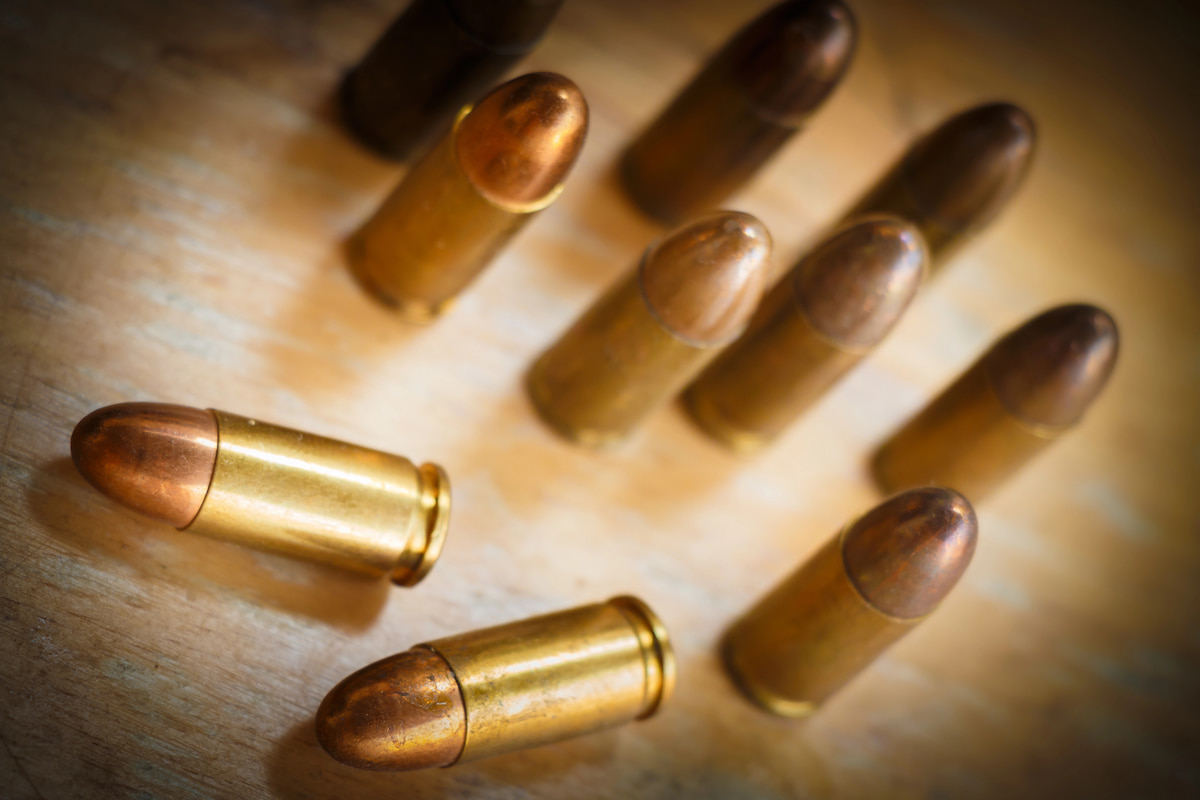
When browsing an ammunition catalog or looking at the engraving on a handgun barrel, you will inevitably run across the acronym “ACP.” So, do you know what is ACP ammo?
ACP stands for Automatic Colt Pistol. It designates a historic family of handgun cartridges engineered specifically for early semi-automatic pistols.
While standard centerfire cartridges have evolved significantly over the past century, understanding what ACP ammo is (and how its structural design functions) remains essential for choosing the right round for your firearm today.
The History and Meaning Behind “ACP” Ammunition
As we mentioned, ACP means Automatic Colt Pistol, which means the cartridge casing lacks a traditional protruding rim, making it ideal for smooth stacking inside a box magazine and seamless feeding into a semi-automatic chamber.
Around 1900, John Moses Browning worked with Colt to create the first successful semi-automatic handguns.
Previously, revolvers used rimmed cartridges to stay seated in the cylinder. But these rims often cause “rim lock” in vertical magazines, where rounds overlap and jam the feed.
To solve this mechanical flaw, Browning engineered the ACP family with a rimless or semi-rimmed geometry.
By utilizing an extractor groove cut directly into the base of the brass casing, Browning ensured that the cartridges could stack smoothly on top of one another and slide up a feed ramp effortlessly, following industry-standard specifications established by organizations like SAAMI.
This breakthrough in casing architecture became the engineering foundation for modern semi-automatic pistol reliability.
The Most Common Types of ACP Calibers
Though John Browning designed several cartridges under this naming convention, three specific ACP calibers continue to dominate the modern shooting landscape:
.45 ACP
Known for its low-velocity, high-mass ballistics, it relies on a heavy projectile (typically 230 grains) to deliver deep terminal penetration and massive energy transfer without needing supersonic speeds.
.380 ACP
The .380 ACP is often referred to as “9mm Short” or “9x17mm.” It utilizes the exact same bullet diameter as a standard 9mm (.355 inches) but features a shorter casing and operates at a much lower internal pressure.
This makes it the premier choice for ultra-lightweight, blowback-operated concealed carry pistols.
.32 ACP & .25 ACP
These smaller cartridges were engineered for ultra-compact European “vest pocket” pistols. While the .25 ACP has largely faded from modern defensive use due to its low kinetic energy output, the .32 ACP still maintains a dedicated following among shooters who value minimal recoil and extreme concealment.
ACP vs. 9mm Luger: The Modern Handgun Evolution
A frequent point of confusion for new gun owners is assuming all semi-automatic handgun ammo falls under the ACP designation.
Specifically, 9mm Luger and its types (also known as 9x19mm Parabellum) are not ACP rounds.
While John Browning was refining rimless cartridges in America, Georg Luger was developing the 9x19mm cartridge in Europe. The core differences come down to geometric taper and pressure limits:
- ACP Design: Straight-walled, lower pressure, optimized for heavy bullets.
- 9mm Design: Slightly tapered, higher pressure, optimized for velocity.
While a .45 ACP relies on sheer bullet mass, modern 9mm ammunition has captured the global military, law enforcement, and civilian markets by maximizing velocity and capacity.
Thanks to advanced jacketed hollow point (JHP) engineering and meticulous jacket concentricity, modern high-pressure 9mm rounds offer identical terminal performance to larger historical calibers, but with significantly less recoil and double the magazine capacity.
FAQs
Is .380 ACP the same as 9mm?
No. While a .380 ACP fires a bullet with the same diameter as a 9mm Luger (.355 inches), the .380 ACP casing is 2mm shorter and operates at a vastly lower maximum pressure limit.
Firing 9mm Luger in a gun chambered for .380 ACP can cause catastrophic mechanical failure.
Can I shoot ACP ammo in a revolver?
Yes, but it typically requires moon clips. Because ACP cartridges are rimless, a traditional revolver’s extraction star has nothing to grab onto to pull the spent casings out of the cylinder.
Specially designed metal “moon clips” hold the rimless rounds together, allowing them to head-space and extract properly in a revolver.
Does .45 ACP have more recoil than 9mm?
Yes. The physics of firing a much heavier projectile (often double the weight of a 9mm bullet) creates a distinct, heavy “push” type of recoil, whereas a 9mm produces a quicker, sharper “snap.”
Conclusions
As we saw, ACP ammo is the foundation of semi-automatic handgun history. While .45 and .380 ACP remain respected options, modern ballistics have established the 9mm Luger as the most efficient and versatile choice for defense and training.
At BC Ammo, we don’t rely on marketing fluff or sensationalized ballistics—we rely on data. Our 9mm ammunition collection is produced in Texas with an obsessive focus on small-batch consistency. Pairing stringently selected brass casings with clean-burning, low-flash propellants, we ensure a predictable pressure curve and uniform velocities box after box.
Whether you are training for a competition or loading your primary home-defense magazines, don’t leave your performance to chance.
Shop BC Ammo’s 9mm collection today and experience true Texas-engineered precision!


