
When shopping for target ammunition, you will constantly see the acronyms FMJ and TMJ stamped on boxes.
Both Full Metal Jacket (FMJ) and Total Metal Jacket (TMJ) serve the same primary purpose: high-volume target shooting, plinking, and training. Because they look virtually identical from a side profile, many shooters assume they are completely interchangeable.
However, while they may look similar from the side, they are manufactured completely differently, altering how they behave inside your firearm’s barrel (and inside your lungs).
This guide breaks down the core structural difference between FMJ and TMJ rounds so you can pick the safest, cleanest, and most cost-effective round according to your specific training needs.
FMJ and TMJ Ammunition: The Core Difference
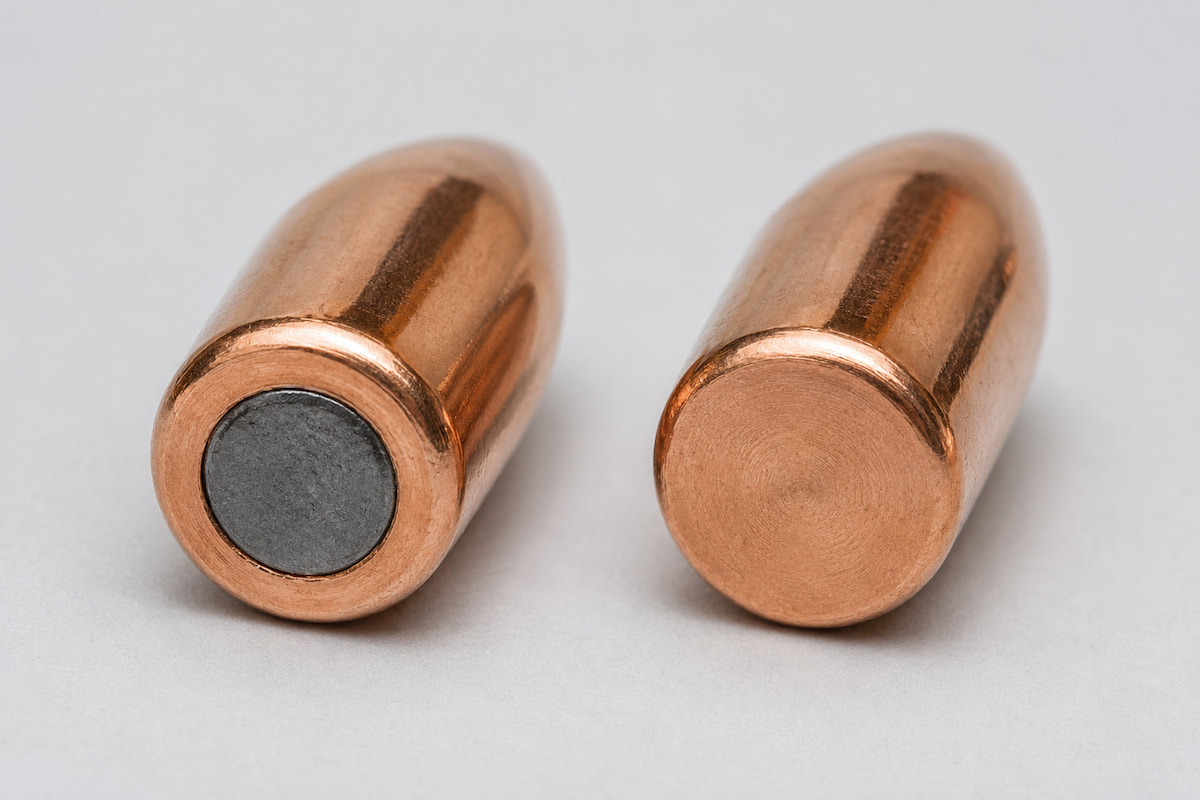
The defining difference between these two bullet types cannot be seen when the cartridge is loaded into a brass case; it is found entirely at the very bottom of the projectile.
Full Metal Jacket (FMJ)
The manufacturing process involves pressing a swaged lead core into a pre-formed metal cup (usually copper).
While this jacket wraps completely around the nose and sides of the bullet, it leaves a raw, exposed lead base at the bottom.
Total Metal Jacket (TMJ)
This design completely encapsulates the lead core in a continuous jacket, ensuring that zero raw lead is exposed to the environment or the burning propellant gasses.
This architectural difference triggers a noticeable reaction during the physics of firing. When the firing pin strikes the primer and ignites the gunpowder, the intense heat and flame hit the rear of the bullet.
With a standard FMJ, this extreme heat instantly vaporizes a micro-layer of the exposed lead base, sending toxic lead gas into the air around the shooter and leaving stubborn lead fouling inside the barrel, which other bullet types like blue bullets don’t do.
Because a TMJ features a sealed copper floor, the heat hits a solid jacket, completely blocking lead vaporization.
| Feature | Full Metal Jacket (FMJ) | Total Metal Jacket (TMJ) |
| Projectile Base | Exposed Lead | Completely Enclosed / Plated |
| Manufacturing Method | Drawing a copper cup over a lead core | Electroplating a chemical copper bath onto lead |
| Jacket Thickness | Thicker, rigid traditional jacket | Thinner, molecularly bonded layer |
| Lead Gas Exposure | Higher (vaporized via exposed base) | Near-Zero (fully encapsulated base) |
| Bore/Weapon Cleaning | Requires regular copper and lead scrubbing | Noticeably cleaner; minimal lead fouling |
| Use with Compensators | Safe; solid jacket resists high-pressure ports | Risk of jacket shearing or flaking at the ports |
In essence, the main real-world differences rely on three distinct operational categories:
Lead Inhalation and Safe Range Training
Indoor shooting creates a unique heavy metal hazard. Igniting an FMJ round releases aerosolized lead at the breech.
TMJ rounds completely seal the lead core, eliminating the primary source of lead vapor and significantly reducing airborne exposure.
This makes TMJ ideal for intensive training in enclosed or poorly ventilated indoor ranges where air filtration is strained.
The Danger of Ports, Compensators, and Suppressors
While TMJ is healthier, it presents technical risks for modified firearms.
TMJ jackets are thin, electroplated layers rather than thick, stamped cups. This makes them fragile; the sharp edges of ports, compensators, or suppressors can shear or flake the copper plating at high velocities.
For firearms with compensators or suppressors, rigid FMJ rounds are safer to prevent accuracy loss from jacket damage.
Gun Cleaning and Accuracy Consistency
Barrel maintenance varies significantly between these rounds. TMJ bases provide uniform gas expansion for superior consistency.
Since no lead vaporizes, the rifling remains free of heavy buildup, making cleaning much faster than scrubbing an FMJ-fouled bore.
FAQs
Is TMJ ammo the same as plated ammo?
Yes. For almost all major commercial manufacturers, “Total Metal Jacket” is simply the industry term used for a heavily copper-plated bullet. Instead of forcing the lead into a pre-stamped copper cup, the manufacturer uses electrical currents to bond copper to the lead atom-by-atom in a chemical bath, covering 100% of the surface area.
Can I use TMJ or FMJ for self-defense?
No. Neither projectile type is engineered for terminal expansion. Both FMJ and TMJ are designed to retain their shape and punch straight through targets.
Forensic studies reveal that FMJ rounds fragment deeply compared to expanding bullets, proving they are unsuitable for controlled defensive applications.
In a self-defense situation, this leads to dangerous over-penetration, where the bullet can pass through a target and strike an unintended object or bystander. Stick to Jacketed Hollow Points (JHP) for defensive use.
Why is TMJ ammo harder to find than FMJ?
Because FMJ remains the century-old global standard for automated ammunition factories. Stamping out traditional copper jacket cups and pressing lead cores into them is highly efficient and cost-effective for massive manufacturing lines. Electroplating lines require highly specialized chemical equipment and longer production cycles, making TMJ a more premium, specialized market segment.
Conclusions
Ultimately, choosing the right target round depends entirely on where you train and what your primary shooting goal is:
- If you are clocking heavy hours at an enclosed indoor facility, invest in TMJ rounds and its clean, lead-suppressed nature.
- If you are conducting outdoor tactical training or utilizing a heavily compensated race gun, invest in traditional and structurally durable FMJ rounds.
At BC Ammo, we build ammunition tailored to the technical realities of modern shooters. Manufactured out of our dedicated Texas facility, our high-quality 9mm collection features tight pressure-curve metering and premium propellants designed to balance exceptionally clean performance with absolute feeding reliability.
Don’t let fouling slow down your training. Explore BC Ammo’s premium 9mm inventory today to find the perfectly matched cartridge for your next training session.


