
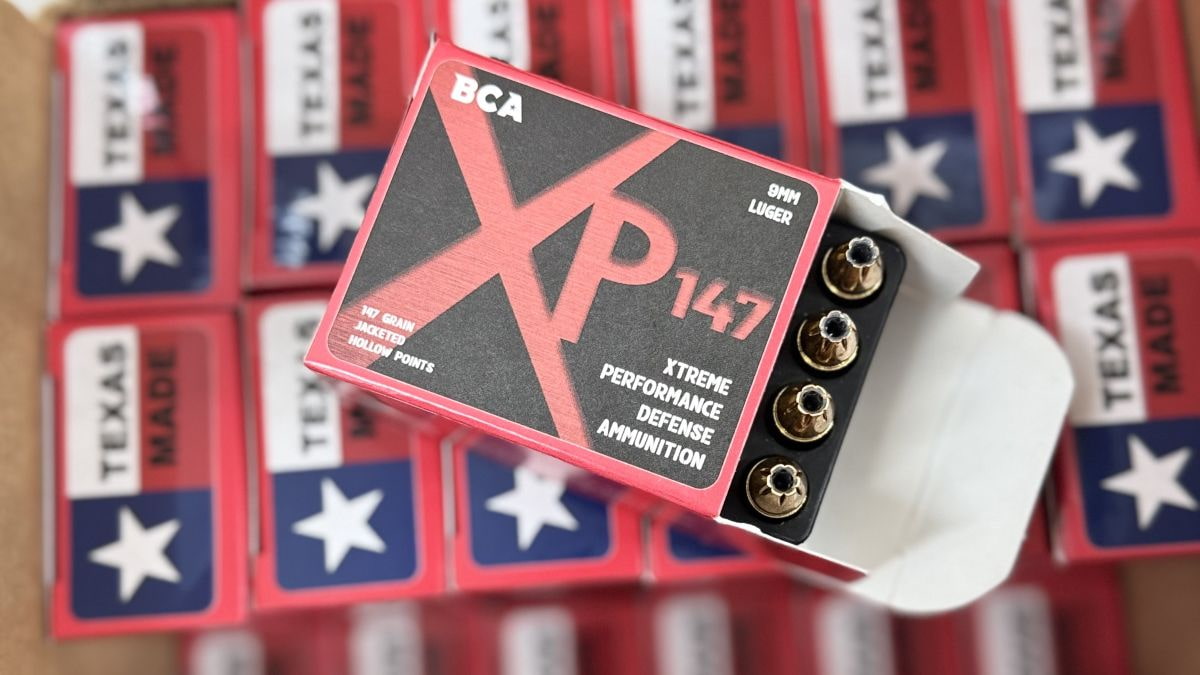
Choosing the right ammunition is the single most important decision for any 9mm owner, especially when balancing cost, safety, and ultimate performance.
Most people struggle with the primary decision: 9mm FMJ vs JHP. While one is built for inexpensive volume shooting, the other is built to save lives. Successful shooters, however, recognize that they cannot rely on a single, expensive box.
The core problem for high-volume shooters is simple: Training with expensive Self-Defense ammo is unsustainable. The solution is relying on a “Complete 9mm Ecosystem” that pairs a cost-effective “Range Partner” with a precise “Duty Load.”
This guide will walk you through the physics and practical application of each round to help you build your system using trusted BCAmmo products.
What is the Difference? (The Physics)
The difference between 9mm FMJ and JHP is purely mechanical and centers on the concept of terminal ballistics (what the bullet does upon impact).
FMJ (Full Metal Jacket)
The round nose and full copper jacket prevent the bullet from deforming or expanding.
This design is robust and easy to manufacture, making it perfect for cost-effective, high-volume practice.
As manufacturers, we understand that optimal reliability requires precise projectile seating and crimping, ensuring every round feeds flawlessly across all pistol platforms.
However, because the bullet stays intact, it tends toward over-penetration, meaning it may pass through a target and continue traveling, posing a risk to anything behind the target.
JHP (Jacketed Hollow Point)
The hollow cavity in the nose is designed to “flower” or expand violently upon impact.
This expansion is crucial because it maximizes the wound channel while dumping the bullet’s energy inside the target, which minimizes the risk of over-penetration and makes JHP the definitive choice for defensive scenarios.
This is not left to chance; our manufacturing process involves meticulous quality control over the depth and uniformity of the hollow point cavity to guarantee controlled, reliable expansion upon impact.
Where and Why to Use Each Round
Understanding the physics allows for a highly practical Two-Round System: JHP for defense, FMJ for range. The data clearly supports this separation of roles:
| Feature | 115gr FMJ (Range) | 147gr JHP (Defense) |
| Velocity | 1,150 FPS (Supersonic) | 990 FPS (Subsonic) |
| Recoil Feel | “Snappy” / Sharp | “Push” / Soft |
| Penetration | 20”+ (Over-penetration risk) | 12”-18” (Optimal FBI penetration standards) |
| Cost | Low | High |
| Best Use | Volume Training | EDC / Home Defense |
The Training Partner: 115gr FMJ
The 115gr FMJ is your financial workhorse. It’s the most common and fastest 9mm load, ideal for high-volume target practice and drills where cost is the main driver.
The Duty Load: 147gr JHP
The 147gr JHP is the preferred defense load. It’s slightly heavier and slower, making it subsonic.
This controlled velocity provides better penetration (adhering to FBI standards) and the expansion needed for defense.
Pro-Tip (The Third Option):
The high cost of JHP makes training expensive. You can introduce the 147gr blue bullets as the next-level training upgrade for serious training.
This is the only way to get the soft recoil of the 147gr defensive load in a cheap practice round.
FAQs
Can I Train with 115gr if I Carry 147gr?
Yes. This is the core of the Two-Round System. Don’t worry about the point-of-impact (POI) shift; at common self-defense distances (7–10 yards), training with 115gr FMJ will translate reliably to your 147gr JHP carry load.
The slight difference in POI is negligible at these close ranges.
What is a Squib Load?
A squib load is a serious, rare safety malfunction where a bullet gets stuck halfway down the barrel due to insufficient powder.
Always check your barrel after a noticeably quiet or “light” primer pop to prevent a catastrophic failure (often called a “bore obstruction”), which can occur if a second round is fired behind the stuck bullet.
Is it legal in the U.S. to use JHP ammunition for concealed carry?
Yes. Unlike military conventions (Hague Convention), which restrict the use of JHP, US civilian and law enforcement bodies widely permit and prefer JHP for concealed carry and duty use.
This is precisely because JHP minimizes the danger of over-penetration that an FMJ poses.
Conclusions
Successful shooting involves understanding the core difference between 9mm FMJ vs JHP and building a system around that knowledge.
The Two-Round System is the most practical and economic strategy for maximizing proficiency without compromising safety. Remember the cardinal rule: FMJ for the range, JHP for defense.
Never use 9mm FMJ for home defense. Because it won’t expand, FMJ risks severe over-penetration through walls, endangering others. Always choose JHP for defense and be absolutely certain of your target and what is beyond it.
Ready to build your complete 9mm system? Start your practice today with high quality, trusted ammo from Buffalo Creek Ammunition, a company built on a decade of handloading expertise, guaranteeing components are sourced and assembled for maximum safety and terminal performance.
Shop our reliable 115gr FMJ for the range and pair it with a box of our trusted 147gr JHP for your daily carry.


